Best Hit Chronicle 1/1 Cup Noodle
55 Years of Cup Noodle
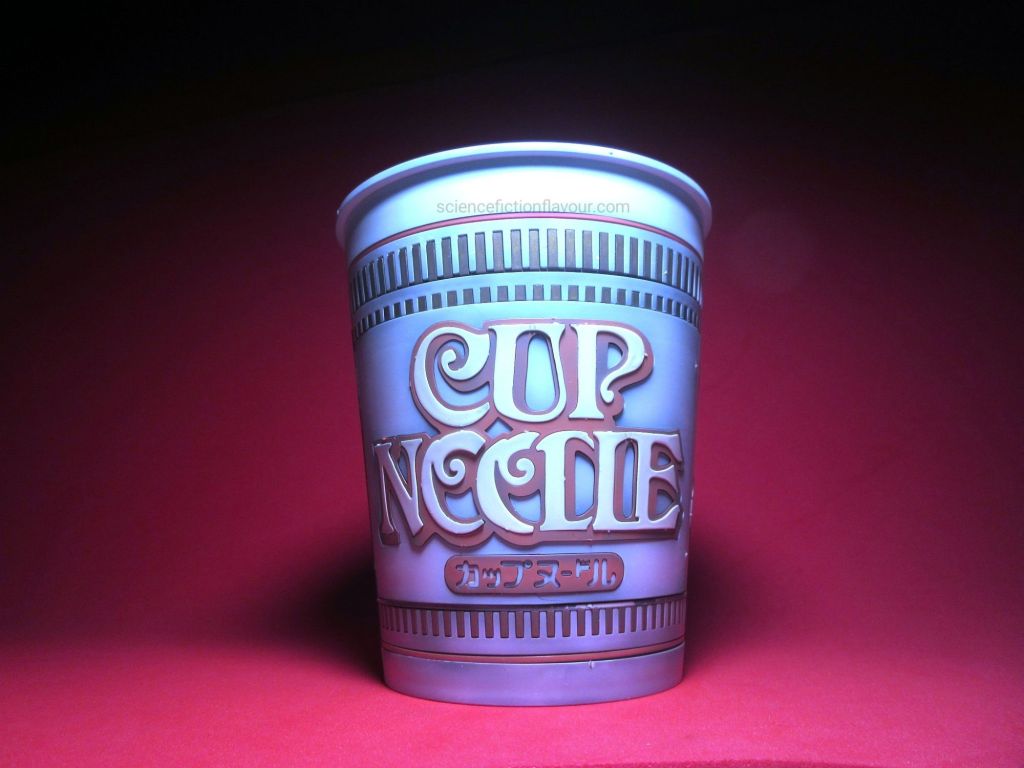
Kit: Best Hit Chronicle 1/1 Cup Noodle
Manufacturer: Bandai
Scale: 1/1
Completed: 18 September 2026
18 September 1971.
According to the instruction manual for Bandai’s Best Hit Chronicle 1/1 Cup Noodle, this was the date when CUP NOODLE was created as the world’s first cup ramen.
So there was something particularly appropriate about completing this kit on 18 September 2026 — exactly 55 years later.
At first glance, a 1/1-scale plastic model of a Cup Noodle might seem like a rather unusual modelling subject. After all, this is an everyday object that we see in convenience stores and supermarkets and probably don’t give much thought to once we have finished eating it.
Building the kit, however, made me look at that familiar object quite differently.
Painting the parts
I started by airbrushing the parts while they were still attached to their runners, using Mr Hobby Mr Color No. 13 Neutral Grey as the base coat.
I then applied different colours to the moulded parts:
- White moulded parts: Mr Color No. 107 Character White
- Red moulded parts: Gundam Color UG10 MS Char Pink
- Gold moulded parts: Mr Color No. 9 Gold
- Simulated noodles: Mr Color No. 109 Character Yellow
The noodle pieces received some experimentation of their own.
I tried Tamiya Panel Line Accent Color Pink-Brown on a sample section of the noodles. The panel wash settled into the texture of the noodle strands and produced a noticeably deeper, warmer appearance. Viewed on its own, it reminded me somewhat of the appearance of noodles in a bowl of laksa.
Since this kit represents Cup Noodle generally rather than a specific flavour variant — such as Curry, Laksa, Chicken or Seafood — I initially decided not to apply the same treatment to the remaining larger noodle pieces.
Interestingly, once the noodles were assembled into the Dense Noodle Cluster, the effect became much less prominent. The individual strands visually blend together, and the variation contributes more to the texture and depth of the noodle mass than to any particular flavour association.
The engineering behind the familiar graphics
Assembly itself was straightforward.
What I found much more interesting was discovering how Bandai reproduced something that we normally take completely for granted: the printed graphics on a Cup Noodle container.
On the real product, we see the artwork and coloured patterns as a continuous printed surface. On this model, however, many of those visual elements are represented by individual coloured-plastic-moulded parts.
The result is an extremely clean separation between colours.
The upper and lower sections are especially interesting. Several ring-like, almost hula-hoop-like subassemblies come together to form the overall printed pattern of the cup.
Once assembled, the eye sees the familiar Cup Noodle design. But looking closely at the model reveals the construction underneath that visual illusion.
It made me appreciate just how much engineering goes into reproducing something that otherwise looks like a simple printed cup.
Bringing the recessed lettering to life
The kit does come with sticker decals, but one particular area made me reconsider whether I wanted to use them.
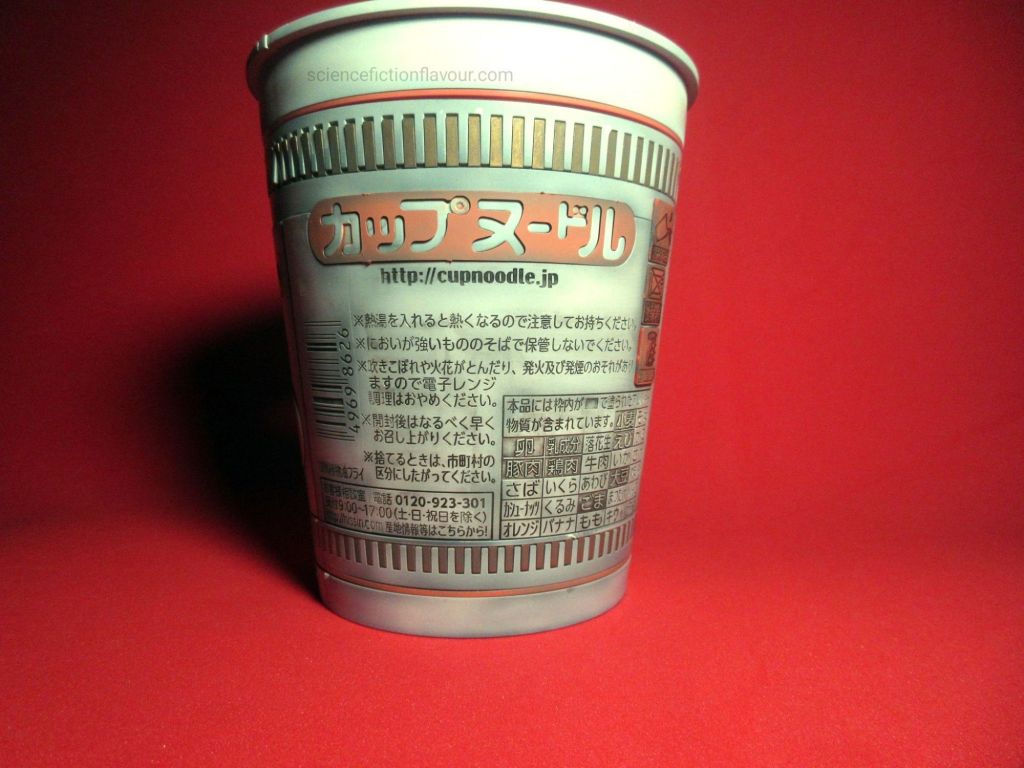
Part B(1) contains the nutritional information and paragraphs of Japanese text. These details are already represented as recesses in the plastic surface.
Since the lettering was already moulded into the plastic, I decided that applying the supplied sticker would obscure rather than enhance the detail.
Instead, I applied Tamiya Panel Line Accent Color Black, allowed it to settle into the recessed lettering, and then removed the excess from the surrounding surface using X-20 Thinner and a cotton bud.
The result was much more satisfying to me.
The black remained in the recessed areas, bringing the tiny Japanese text and nutritional information into view. What had initially appeared to be barely noticeable moulded detail became much more visible.
It felt less like applying a representation of the printing and more like revealing the detail that was already physically present in the model.
Choosing not to use the lid stickers
I made the same decision with the supplied Lid Sticker and Lid Stopper Sticker.
I ultimately left both off.
This wasn’t because the decals were poorly conceived. Rather, by this point in the build I had become increasingly interested in the physical construction of the kit itself.
The more I looked at the model, the more I wanted its moulded engineering, colour-separated components and recessed details to remain visible.
For me, that became part of what made this particular build interesting.
More than a plastic Cup Noodle
This kit also made me think about the difference between the price of an everyday product and the value of the engineering behind it.
A Cup Noodle is, ultimately, an inexpensive food product. We buy it, prepare it, eat it and throw away the container.
The Best Hit Chronicle kit takes that familiar disposable object and turns it into something that we examine, assemble and preserve.
And in doing so, it exposes some of the engineering that is normally hidden from us.
The real Cup Noodle’s graphics appear to be simply printed onto the cup. The model reveals that those visual elements can be broken down into multiple physical components and carefully assembled to recreate the appearance.
The recessed lettering on B(1) is another example. On the real product, it is simply part of the printed packaging. On the model, the lettering exists as physical geometry in the plastic.
The real Cup Noodle hides its construction behind its familiar appearance. The model kit makes some of that construction visible.
That is probably what I appreciated most about building it.
Rather than simply reproducing the appearance of a Cup Noodle, Bandai has created a 1/1-scale model that lets the builder examine how that appearance can itself be constructed.
55 years later
Completing the model on 18 September 2026, 55 years after the date given in the instruction manual for the creation of Cup Noodle, gives the build an additional significance.
It is still a playful subject — after all, it is a plastic model of a cup of noodles.
But it is also a small examination of an everyday object that has become deeply familiar.
The finished model now sits as a permanent, plastic representation of something that was originally designed to be consumed and discarded.
And perhaps that is the charm of the Best Hit Chronicle series.
It encourages us to look again at objects that are so familiar that we normally stop noticing them.
For this Cup Noodle, that meant looking past the printed graphics, past the noodles and even past the food itself — and appreciating the design, moulding and engineering that make the familiar object possible.
18 September 1971 → 18 September 2026.
55 years of Cup Noodle, commemorated in 1/1 scale.
 Science Fiction Flavour