HG 1/144 Mobile BuCue — SEED × DUNE: A What-Should-Have-Been
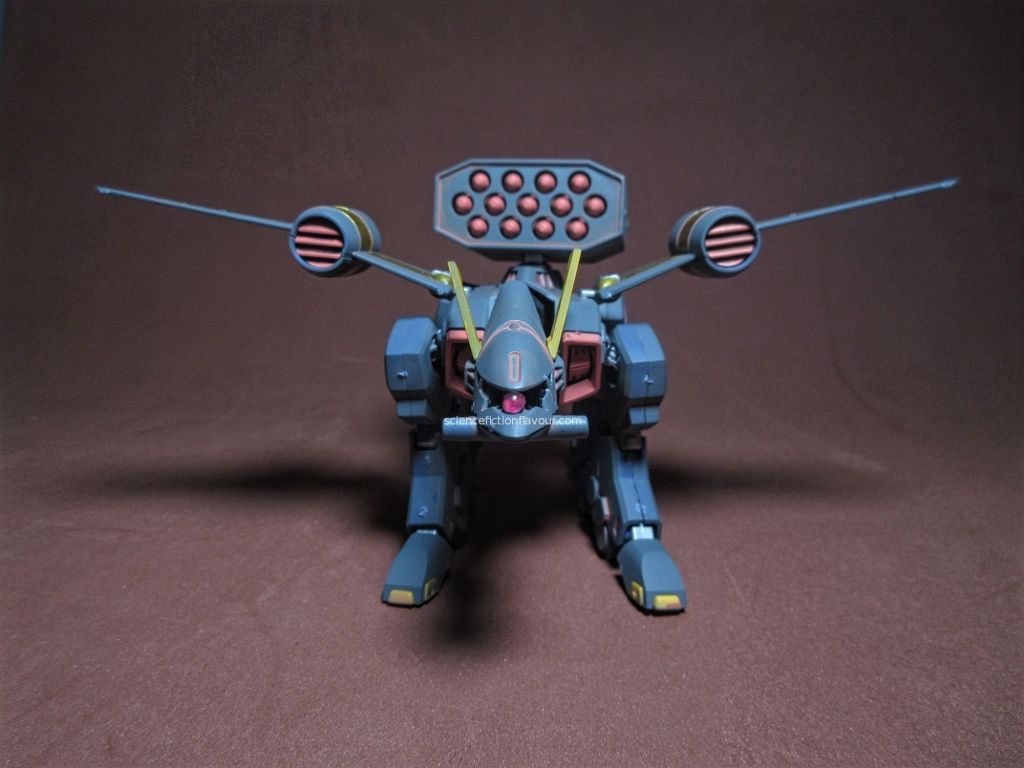
I have been working on Bandai’s 1/144 HG Mobile BuCue over the past few days, and what started as another modelmaking project gradually became something more personal.
The BuCue is one of the more distinctive machines from Mobile Suit Gundam SEED: a four-legged, low-slung ground-combat Mobile Suit that looks less like a conventional humanoid robot and more like an armoured mechanical hound. Its desert-combat character made it particularly appropriate for an idea that had been sitting in my mind since 2024.
I began the build in my usual way, soaking the runners in soapy water before using a toothbrush to rinse away the residue. After leaving the runners and parts to dry, I airbrushed the solid-coloured moulded parts with Mr Hobby Mr Colour No. 13 Neutral Grey.
The red moulded parts were subsequently airbrushed with Gundam Colour UG10 MS Char Pink, over the Neutral Grey base. The yellow parts received Mr Colour No. 109 Character Yellow, also over the grey base. For the joint components, I used Mr Colour No. 8 Silver over the Neutral Grey, giving the mechanical areas a more metallic appearance.
Once the paint had dried, I moved on to panel lining. The Neutral Grey surfaces received Tamiya Panel Line Accent Colour Pink-Brown, while the MS Char Pink areas and silver mechanical components received Tamiya Panel Line Accent Colour Black. After allowing the panel liner to dry, I removed the excess with cotton buds moistened with Tamiya X-20 Enamel Thinner.
Then came assembly—and this was where the build started becoming distinctly my own.
Some of the BuCue’s components have an aircraft-wing-like appearance, accompanied by engine-like compartments and sticker details. Instead of using the supplied stickers, I decided to highlight those areas with a gold permanent marker.
While working on those parts, I also decided to inscribe the words “SEED” and “DUNE” onto the wings, taking inspiration from the typography of the Dune film logo.
Why?
Back in 2024, Gundam SEED Freedom and Dune: Part Two were promoted together in a special cinema collaboration. The official crossover artwork placed the SEED Freedom protagonists at the centre of the visual. My personal feeling was that a desert-themed SEED × Dune collaboration could have taken a different direction.
Instead of focusing on the characters of SEED Freedom, I imagined the machines and characters associated with the desert operations of the original Gundam SEED taking centre stage.
Hence the BuCue.
This build is my little tribute to a “what should have been.”
I wanted to take an actual desert-combat Mobile Suit from Gundam SEED and reinterpret it through the visual language of Dune. The BuCue seemed almost tailor-made for that idea: a quadrupedal machine charging across a desert landscape, looking more like some enormous mechanical hunting beast than a conventional Mobile Suit.
I also decided not to use the supplied sticker for the BuCue’s monoeye camera.
Instead, I cut a small piece from the leftover clear-pink plastic runner, shaped it and glued it onto the head as a physical optical element. The recessed area surrounding the camera was then shaded with a fine-tip black marker. The dark surround creates contrast against the translucent pink piece, allowing the monoeye to read more like an actual recessed sensor rather than a flat sticker.
Toward the end of assembly came another choice. The kit provides the option of equipping the BuCue with either a twin-cannon turret or a multi-rocket launcher battery.
Naturally, I tried both.
I also tried the BuCue’s famous dual beam sabers once.
And honestly, it is hilarious.
With the two sabers mounted in front, the BuCue looks like a mechanical hound biting down on a double-edged sword and charging straight at its opponent.
But after giving the configuration a try, I set it aside.
My favourite is the rocket launcher.
The rocket battery reinforces the BuCue’s identity as a desert assault machine. Low, wide and four-legged, it looks like something built specifically to race across hostile terrain while delivering a considerable amount of firepower.
Which brings me back to the two words on its wings:
SEED. DUNE.
This isn’t an attempt to recreate an official Bandai or film collaboration. It is my own interpretation of one—a small-scale model that combines a machine from Gundam SEED with the visual language and atmosphere of Dune.
And I deliberately wanted to finish it today, 22 September 2026.
Today marks the release of Dune: Awakening on PlayStation 5 and Xbox Series X|S, bringing Funcom’s journey across Arrakis to console players.
So there was something fitting about finishing a desert-themed BuCue on the same day.
A machine from one fictional desert battlefield, reworked through my own SEED × DUNE interpretation, now marks the arrival of another journey across the sands of Arrakis.
A little experiment in paint, markers, plastic and imagination.
A little piece of “what should have been.”
And, appropriately enough, it is finally complete on a day when we return to the desert.
SEED × DUNE.
 Science Fiction Flavour